
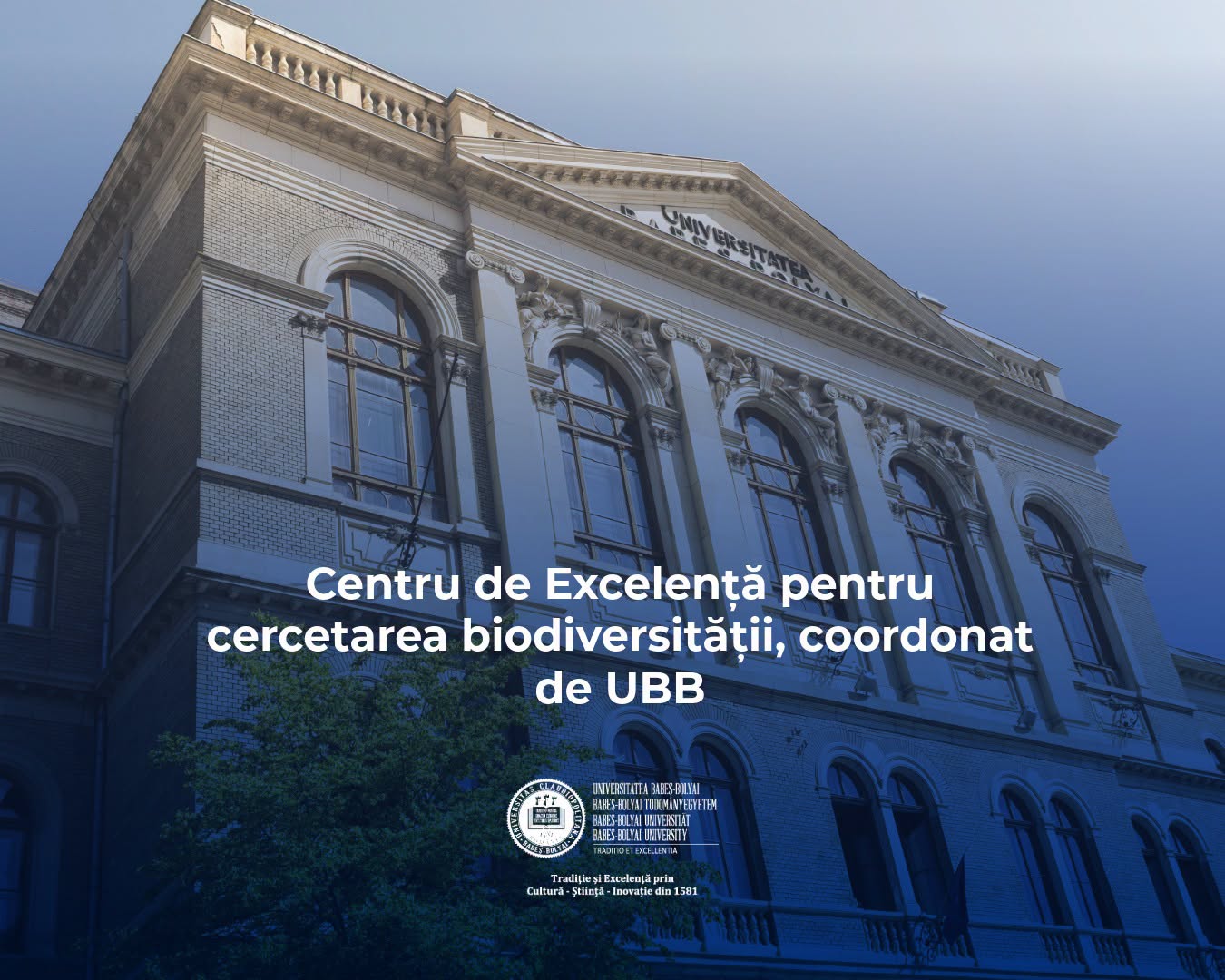
Seven Romanian universities and research institutes are pooling their expertise within the new RECOVER – the Romanian Center of Excellence in Biodiversity, Ecosystem Services, and Society. The center aims to contribute to a better understanding of how climate change and human activities influence biodiversity and ecosystems. The research results will contribute to the development of solutions for the long-term protection and restoration of ecosystems and the benefits they provide to society.
Coordinated by Babeș-Bolyai University, the consortium includes the University of Bucharest, Ovidius University of Constanța, the Institute of Biology Bucharest, the Institute of Biological Research Cluj (a branch of INCDSB Bucharest), the National Research - Development Institute for Marine Geology and Geoecology (GeoEcoMar), and the National Institute of Research and Development for Environmental Protection. The partners bring together expertise and research infrastructures for the study of terrestrial and aquatic ecosystems and the relationship between humans and nature.
The first in-person meeting of the RECOVER partners will take place on September 23–24, 2026, in Sfântu Gheorghe, as part of the center's inaugural workshop. On this occasion, the partners will discuss the priorities of the joint research program alongside representatives of local communities, practitioners, and public authorities.
What will RECOVER do?
Over the next few years, research conducted at RECOVER will follow the changes that biodiversity and ecosystems are undergoing, as well as opportunities for their conservation and restoration. The studies will cover diverse ecosystems, from forests, grasslands, agricultural land and urban areas to rivers, wetlands, the Danube Delta and the Black Sea.
„RECOVER creates a common framework in which theoretical and applied ecology, the study of ecosystem services, biocultural systems and governance are connected to understand biodiversity changes, opportunities for ecological restoration and transform theoretical knowledge into solutions. We will research both ecosystem pressures and vulnerabilities, and positive examples (communities, practices and initiatives) that can inspire nature conservation and restoration.” Associate Professor PHD Tibor HARTEL, coordinator of RECOVER project
An important component of RECOVER will also be the strengthening of the research environment, ensuring that scientific performance does not depend on isolated individual efforts but becomes the systemic result of collaboration, shared resources, and support for researchers. In this regard, RECOVER will contribute to developing expertise and research capacity in the field of biodiversity. Researchers will have access to training and collaboration opportunities, and ties with the international scientific community will be strengthened. The knowledge and expertise developed within the center will also be leveraged beyond the academic environment through methods, recommendations, and resources useful to practitioners and decision-makers.
The inaugural RECOVER workshop in Sfântu Gheorghe
The inaugural workshop in Sfantu Gheorghe is the moment when the expertise of the seven institutions is put at the same table, in order to exchange experience and resources, to identify priority challenges and to integrate them into the common research program.
The workshop will also create a space for dialogue with representatives of local communities, practitioners and authorities, bringing forward perspectives and challenges from the field. This dialogue will help anchor the RECOVER research into local realities and needs from the outset.
About RECOVER project
The RECOVER Project - Romanian Centre of Excellence in Biodiversity, Ecosystem and Society Services, code PN-IV-P6-6.1-CoEx-2024-0124, benefits from a financing of 85.9 million lei.
Funding is granted through the National Research, Development and Innovation Plan 2022–2027 (PNCDI IV), Program 5.6 – Challenges, Sub-programme 5.6.1 – Partnerships for the Strategic Agenda, Centre of Excellence (CoEx) competition.
The project falls within the research domain "Food, bioeconomy, natural resources, biodiversity, agriculture, and environment," with the thematic area/impact area "Biodiversity recovery, sustainable conservation and restoration of ecosystems and ecosystem services."