
Geochemistry Team
Staff:
- Drd. Vasile-Sorin BALAN, CSIII
- Drd. Andra Ștefania BUCȘE, CSIII
- Florina MĂCĂU, Chimist I
- Florina RĂDULESCU, Chimist I
- Teodor MUȘAT, AC
- Ștefan VLAD, Tehn.
- Daniela FLOREA, AC
The research activity carried out by the team’s members within the numerous national and international projects in which they are involved in consists of:
- Study of biogechemical cycles in the marine environment;
- Physico-chemical characterization of the water column;
- Studying the eutrophication phenomenon, as well as pollution in both the marine and freshwater environments;
- Studying the main components (major and minor) of marine sediments;
- Geochemical characterization of marine and freshwater sediments;
- Studying the greenhouse gas fluxes at the water-atmosphere interface;
- Implementation of European Directives (Marine Strategy Framework Directive, Maritime Spatial Planning Directive.
The team’s members work both in the Geochemistry laboratory of INCD GeoEcoMar and on board the Mare Nigrum research vessel, where water, sediment and biota samples are taken, and in situ measurements of the concentrations of the main greenhouse gases, of the physico-chemical parameters of seawater, as well as laboratory analysis on board the ship (nutrients, H2S, are made SO42-B) are made.
The infrastructure of the geochemistry laboratory mainly consists of:
- 35 UV-VIS Lambda (Perkin Elmer) Spectrometer – nutrient, chlorophylls and chlorophyll degradation products analysis;
- SPECTRO XEPOS XEP 05 energy-dispersive X-ray fluorescence spectrometer – analyses of major, minor and trace components in sediments, analyses of heavy metals in biota;
- 939 SOLAR E atomic absorption spectrometer, with flame atomization and graphite furnace– heavy metal analysis from water and sediment;
- DMA 80 mercury analyzer (Millestone) – total mercury and metal mercury analyses in water, sediments and biota;
- TOC/TN FORMACS HT (SKALAR) analyzer – analyses of total organic carbon (dissolved, particulate) and total nitrogen in water;
- Agilent 7890 A gas chromatograph, with quadrupole mass spectrometer – organic pollutant analyses – PAH, PCB;
- BERGHOFF MWS – 2 microwave digestion system;
- DIONEX ASE 300 solvent extraction system – GC sample preparation – GC sample preparation;
- RETSCH 200 RM Mechanical Saw;
- Manual pellet press PP 25 (RETSCH) – preparation of sediment samples for XRF analysis;
- KERN analytical balances (ABS 220-4N and ABT 220-5DM)
- Graphite furnace;
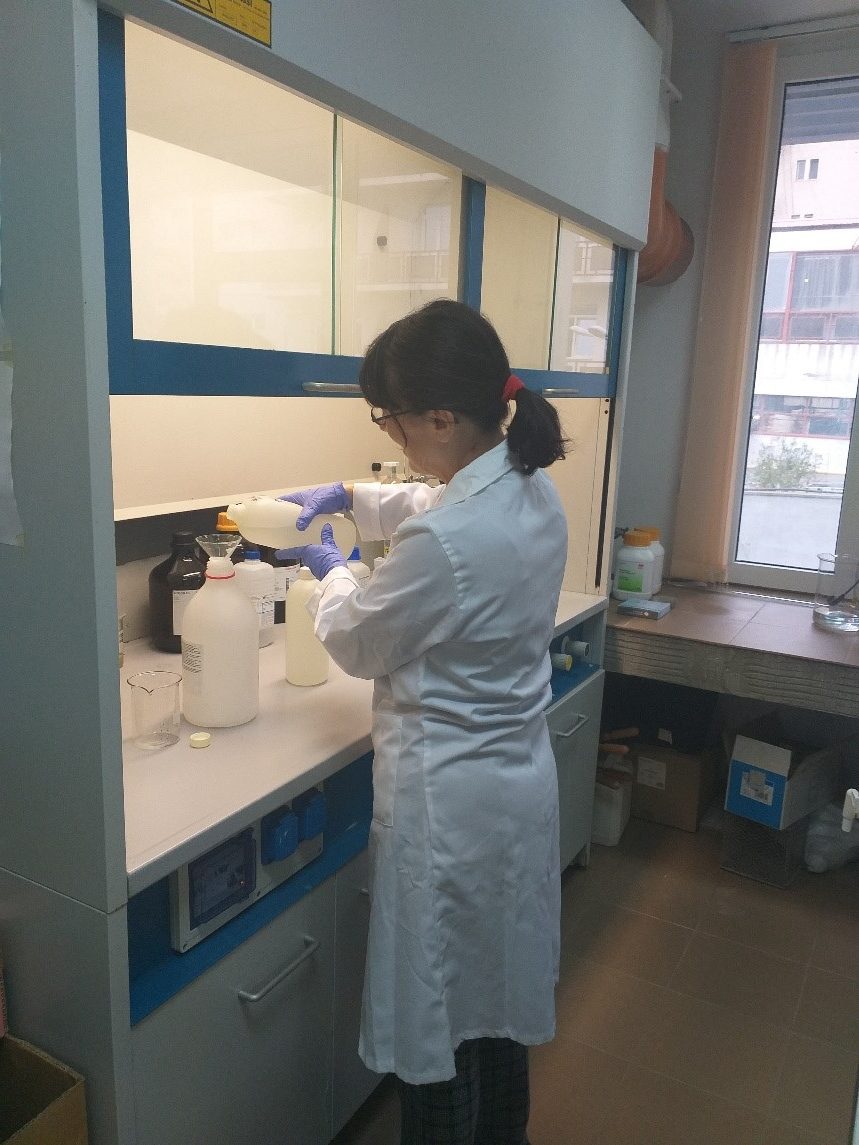
- TALASSI Chemical niche with exhaust, ma 90 serie;
- HEIDOLPH rotary evaporator;
- BINDER natural convection oven ED 400 (-5 °C – 300 °C);
- ilShin freeze dryer – preparation of sediment and biota samples;
- ULTRACLEAR GP 10 TWF 30 UV ultrapure water system;
- DIGITIZED automatic burettes – CaCO3 and TOC analyses in sediments;
The equipment on board the Mare Nigrum research vessel operated by the members of the Geochemistry team consists mainly of:
- CTD system (rosette SBE 25, SBE 32 equipped with 12 Niskin cylinders) equipped with various sensors (dissolved oxygen, fluorescence, turbidity, pH, ORP, light attenuation, etc.) – taking seawater samples and performing in situ measurements of physicochemical parameters;
- Multicorer MARK II-400 – sediment sampling;
- Multi-gas photoacoustic analyzer in IR (INNOVA1412);
- Portable spectrometer DR 1900 (HACH) – nutrient analyses, hydrogen sulfide, sulfates, turbidity, color, etc.) performed on board the ship;
- Vacuum pumps (Millipore) and Nagelne filtration systems;
- HANNA multiparameter kit.
Galerie foto