
Mineralogy and Granulometry Team
Staff:
- Dr. Ing. Bogdan Gabriel ISPAS, CSIII
- MSc. Adrian PARTALE, Tehn. I
- Conf. dr. Glicherie CARAIVAN, CS II
The specific research activity of this department is represented by specialized studies in identifying the mineral species, especially those of high density, and determining the size of the mineral grains.
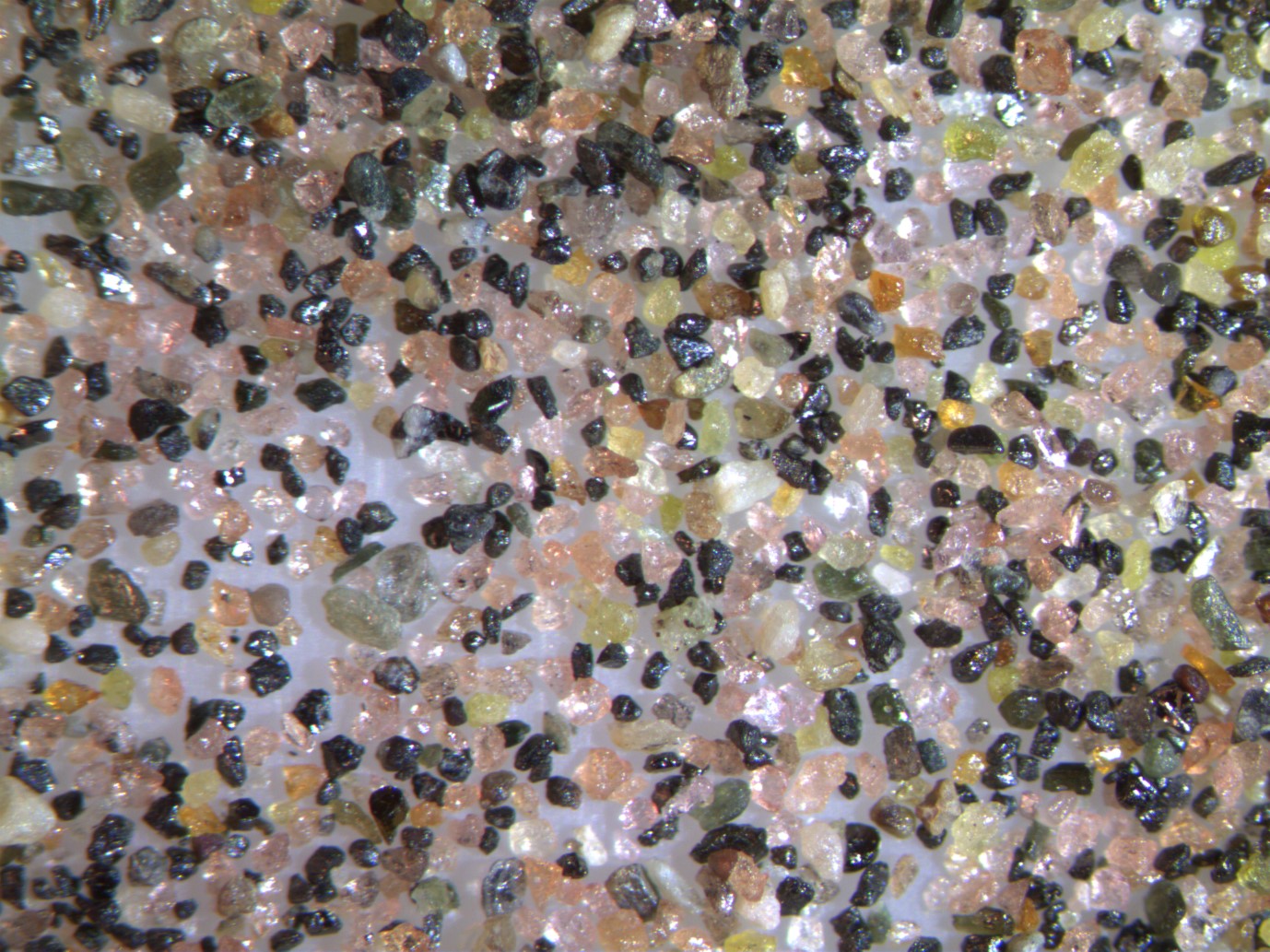
Mineralogical analysis can indicate the source area of sediments by identifying heavy mineral associations. The process of separating minerals can be done using a magnetic separator or by gravity separation in heavy liquid. Mineral identification is done with a stereomicroscope or a polarizing microscope.
The laboratory activity consists of the granulometric analysis of sediment samples either by laser diffractometry, in the case of clays and silts, or by the sieving method, in the case of sands and gravels. In the case of heterogeneous sediments, which contain clay and silt particles along with coarse elements, the samples are analyzed by the combined diffractometry – sieving method.
The separation of granulometric categories (classes) (gravel, sand, silt, clay) and the fractions within each category are in accordance with the Udden – Wentworth logarithmic scale, completed with the detailing of three fractions, at 1Ф intervals, in the clay field.
Laboratory equipment:
“Mastersizer 2000E Ver. 5.20” – Malvern Granulometric analyzer;
“AS 200 Basic” – Retsch Vibrating sieving machine;
Set of 6 standardized Retsch sieves (63, 125, 250, 500, 1000 and 2000 μm);
“L2” Franz Magnetic separator;
Camera equipped Olympus “SZ61” Stereomicroscope;
„Stemi 2000 C” Zeiss Stereomicroscope
Zeiss Jena Polarized light microscope;
Sartorius „BP210S” Analytical balance;
Memmert “UM200” drying oven;
Galerie foto