
Romanian geophysics has developed since its inception in a dynamic closely correlated with the international developments of Earth Physics, actively contributing to its transformation into an integrated science of the Earth system. The premises for the emergence of geophysics were created in the first decades of the 20th century, with the consolidation of a solid tradition in geodesy, astronomy, and geology. In this context, the founding in 1906 of the Geological Institute of Romania, under the leadership of Ludovic Mrazec, represented the founding institutional moment that made possible, almost two decades later, the initiation of organized geophysical prospecting. The year 1925 marks the official debut of the Romanian geophysics by integrating the gravimetry, the magnetometry, the electrical methods and, later, the seismics in the exploring of the underground resources.
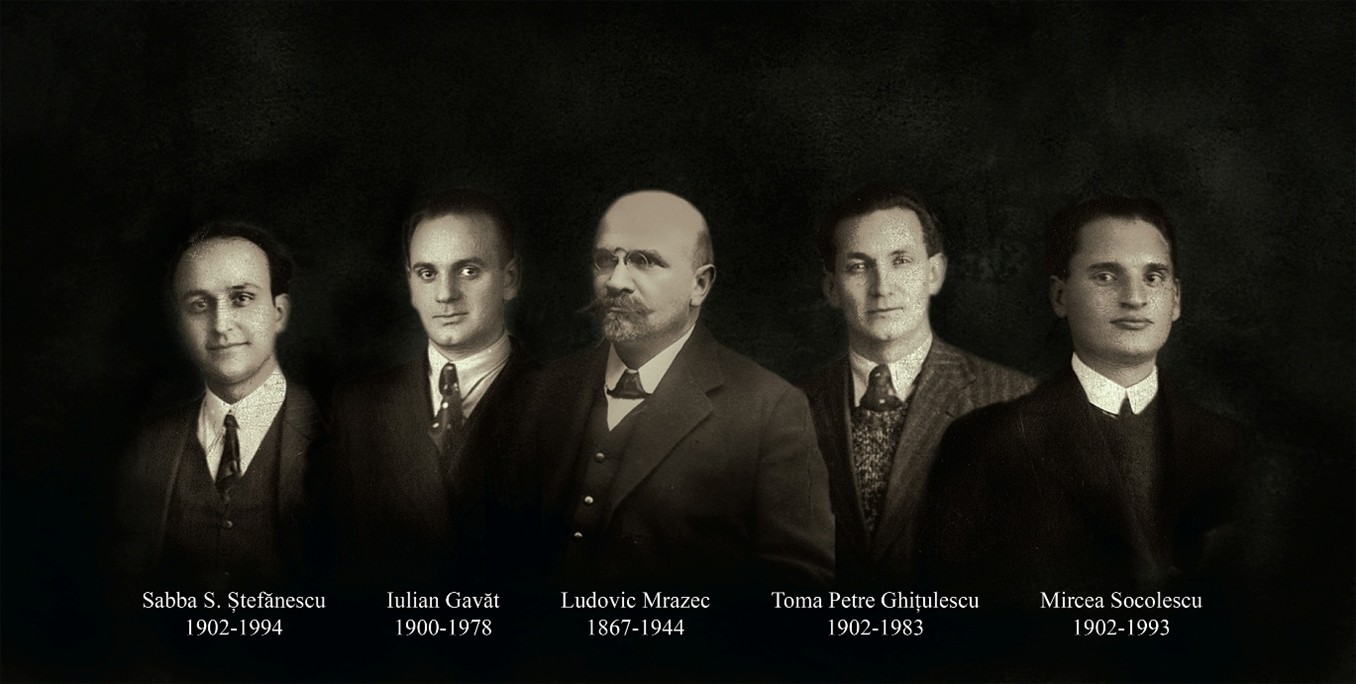
This is the background on which the first wave of the founders of the Romanian geophysics takes shape, grouped around Ludovic Mrazec, a geologist of international renown, author of the theory of salt diapirism – a model known today in the specialist literature as the “Mrazec diapir”. Realizing very early that the future of subsurface exploration would depend on the indirect physical methods, Mrazec created the framework in which geology and geophysics would organically meet. A constellation of personalities forms around him who transforms the geophysical prospecting from experimental endeavours into mature scientific tools: Sabba S. Ștefănescu, a pioneer of electrometry and the co-founder of the Romanian school of geophysics; Iulian Gavăt, the founder of Romanian gravimetry, who introduced the torsion balance and organized the first systematic gravimetric networks; Toma Petre Ghițulescu, an explorer of gold–silver deposits in the Apuseni Mountains and promoter of applied geophysics in the field of mineral resources; and Mircea Socolescu, a researcher and professor who decisively contributed to the development of the national geophysical infrastructure and to the promotion of an integrated geology–geophysics vision.
On the basis created by this first wave, a second wave of major personalities rises after the mid-20th century, bringing the Romanian geophysics to theoretical and institutional maturity. Liviu Constantinescu, seismologist and geomagnetist, played an essential role in understanding the seismogenic structure of Romania, especially in the Vrancea zone, and in modernizing geomagnetic observations. At the same time, he supported the organization of the observatory infrastructure and the training of new generations of specialists, placing Romanian geophysics in direct dialogue with the international developments. Radu Botezatu asserted himself as a geophysicist of global tectonics and regional models, synthesizing through his works – especially Geophysical Models of the Geological Structure of Romania – the body of gravimetric and magnetic data into a coherent vision of the deep structure of the Carpathians, platforms, and intracontinental basins. Together, Constantinescu and Botezatu consolidated the Romanian school of geophysics, modernized the measurement infrastructures, and structured the field into well-defined research institutes and university departments.
Geophysics, as a whole, is affirmed as an integrated science of the Earth, using concepts and methods of physics to study the solid interior, the hydrosphere, the atmosphere, and the cryosphere, as well as the gravitational, magnetic, electric, and electromagnetic fields that interconnect them. Its structural duality – between Earth Physics, oriented towards fundamental mechanisms (internal structure, tectonics, magnetic field, climate), and applied geophysics, oriented towards resource exploration, hazard assessment, and infrastructure safety – is the key to geophysics’ capacity to connect theoretical knowledge with the practical decision-making. Theoretical models provide the conceptual framework for interpreting signals measured in the field, while the data derived from applications supply the critical tests needed to validate and refine these models.
At the applied level, Romanian geophysics has evolved from classical gravimetry and magnetometry to a complex portfolio of modern techniques: 2D and 3D seismics, microseismics, advanced electrical and electromagnetic methods, ground-penetrating radar (GPR), high-resolution gravimetry and magnetometry, satellite radar interferometry (InSAR), and 4D monitoring of natural or anthropogenic reservoirs. These methods are used today in the exploration of hydrocarbons and mineral resources, in geotechnical and infrastructure studies, in geothermal exploration, in carbon capture and storage projects, as well as in natural hazard assessment. Petrophysics, as a bridging discipline between the measured physical properties of rocks and their geological nature, plays an essential role in transforming geophysical anomalies into consistent geological models, without which the interpretation would remain ambiguous.
The development of Romanian geophysics is closely linked to the institutions in which this activity has been and continues to be carried out. The Geological Institute of Romania, Prospectiuni S.A., the National Institute for Research and Development in Earth Physics, the “Sabba S. Ștefănescu” Institute of Geodynamics, GeoEcoMar, together with the Faculty of Geology and Geophysics of the University of Bucharest and other university centres, constitute the infrastructure through which the tradition is transmitted, modernized, and integrated into European and global scientific networks. At the same time, graduates trained in the Romanian school of geophysics have reached leading positions on the international scene, confirming the robustness of the academic training and the capacity of this school to generate excellence.
In the 21st century, Romanian geophysics faces major challenges but also significant opportunities. Seismic hazard in Vrancea, urban subsidence, the stability of critical infrastructures, responsible resource exploration, geothermal development, the use of the subsurface for CO₂ storage, and the need to adapt to climate change are just a few of the areas in which the contribution of geophysics becomes indispensable. The centenary is not only an occasion for homage, but also a reaffirmation of a mission: to continue investment in research, infrastructures, education, and international collaboration so that Romanian geophysics remains a relevant actor in understanding and managing the processes that shape the Earth and society,
An exhaustive presentation of Romanian geophysics over the last 100 years can be read at https://acad.ro/institutia/sectia_7_a.html